One quarter into my MHA, here's what I learned/think about health care reform:
An acceptable level of overall population health at a reasonable cost requires universal access to health care via single program. This means that residents of all ages are in the same program, without the fragmentation of Medicare/Medicaid, employer insurance, self insurance, and out-of-pocket payment. (I'd leave the VA alone because those patients have unique needs that civilian health care is not set up to handle.)
Universal access is a prerequisite, not a guarantee
Improved outcomes and savings require robust federal, state, and community public health policies aimed at containing the dangerously rapid increase in obesity, and the major chronic diseases of asthma, cancer, depression, diabetes, and heart disease. (Obesity is a risk factor in all five)
Improved outcomes and savings also require a system based on primary care, not specialties. Currently, 30% of U.S. physicians are primary care doctors. The number should be 50%, at least.
Overtreatment in some areas and undertreatment in others is a problem traceable in part back to the high proportion of specialists
The state of health information technology is dismal
As politically significant an accomplishment as it is, the Affordable Care Act mostly buys time and doesn't address the issues of cost or quality. (In fairness, it isn't designed to.)
Only so much can be accomplished by government at any level. Much reform must come from within the system
Regarding the economics of American health care, it is supply driven and not demand driven. That is, an area with more heart surgeons with have more heart surgery than an area with fewer, but it is unlikely that overall cardiac health with differ significantly between the two
My right to access a health care system and the public interest in community health supersedes your right to choose to not access the system
In short, there's much good work to be done...
Yesterday, U.S. District Judge Henry Hudson struck down the portion of the Affordable Health Care that mandates the purchase of health insurance on the grounds that the individual right to not purchase health insurance supersedes anyone else's right to purchase it and the community interest in public health. Ian Millhiser thinks that Hudson's opinion reveals the weakness of the hand being played by the opposition. I think the ruling is not only misguided, it places ideological correctness ahead of addressing what should be considered a threat to our national security. It's simply foolish to be taking an option off the table when it doesn't involve shipping people off to gulags.
Premium T. treks to Ballinrobe, Roundfort, Kilmaine, and Cong on a Harry Clarke pilgrimage. Clarke was the Michelangelo of stained glass, and five churches right here in County Mayo can boast examples of his brilliance. The locals we conferred with in a Roundfort didn't know this, though, and had trouble getting their heads around the idea that two people from Seattle would visit Roundfort intentionally. One older gentleman may have known who I was talking about; it was hard to tell as his Mayo brogue bordered on brick-like thickness. As we drank tea (on the house, it turned out), the men at the bar placed bets on televised horse races. The publican phoned them in while a 30-ish blonde out of an Edna O'Brien novel surveyed the proceedings quietly from her perch at the end of the bar.
You've seen her before: No rivals in Roundfort, but just another pretty face in Dublin. She appreciates the male attention, but despairs of her choices. She hates Roundfort, but fears to leave...
I can recommend spending a cool Friday evening seeing Jackson Browne at the Chateau Ste. Michelle winery in Woodinville, WA. At 61 and performing before an audience of his peers, Browne might have been expected to take it easy by running through a brief set of favorites. But, like more musicians than we care to admit, Browne is a consummate pro who delivered a confident set played by an outstanding band. Though not blessed with great stage presence -- Bruce Springsteen would have had us on our feet pumping fists all the way through "The Pretender," while Browne all but tossed away the crowd-pleasing lines -- he performed both the confessional and topical songs with convincing intimacy.
He reached back as far "Doctor My Eyes," but didn't lose anyone's interest during a impressive rendering of "Giving That Heaven Away" from Time the Conqueror (2008). In between, we got "Take It Easy," an acoustic version of "For Everyman," "Fountain of Sorrow," "For a Dancer," "Bright Baby Blues," "The Pretender," "Running on Empty," "In the Shape Of a Heart," "I'm Alive," "I Am a Patriot," and many others. "For A Dancer," "I'm Alive," and "Take It Easy" stood out for me; T. was especially taken with "I Am A Patriot" and its hybrid of gospel and reggae.
Luckily, guitarist David Lindley -- who now looks like a cross between Ben Franklin and a Disneyland character -- reunited with Browne for this tour. His lap steel and violin remain the bedrock of Browne's sound: I've seen Jackson with and without Lindley; there's no question that songs convey their intent more successfully when Lindley helps put them across.
So, excellent show; don't miss miss Jackson when he comes to a town near you. He's still got it.
Barack Obama, it seems, is "viscerally antibusiness." Why? Well, it seems that he forced the CEO of General Motors to resign as part of the government takeover of the iconic company that successive CEO's had run into the ground. He prevented Wellpoint Insurance from evading provisions of the new health care law. He criticized as personally greedy the investment bankers who turned to government to avoid eviscerating the world's economy. And, of course, he exacted from BP the $20 billion escrow fund in large part because he and the American people doubted BP's sincerity in paying claims for damages.
For eight years, the boys got to play all by themselves without adult supervision; they delivered results that were more antibusiness than anything Barack Obama could come up with. Now a grownup has come along, called them on their shenanigans, and tried to impose a little discipline. So, the boys are fwowing tantwums. Well, Barack Obama didn't make GM design cars that no one wanted to buy, nor did he tell Wellpoint to pull a fast one. It wasn't him who constructed a financial version of the Ottoman Empire built on the shabby and barbarous foundation of predatory loans. And it's Tony Hayward who runs a $300 billion company that preferred to risk an entire ecosystem rather than use a half million dollar part (.00000167 per cent of the value of the company, in case anyone wants to know).
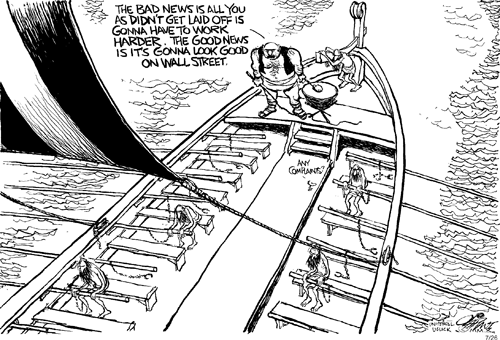
I spent a career in the corporate world. These frauds aren't getting half of what they deserve. Boys, you've made the world sick; the least you can do is take a little medicine...
Slate's Michael Newman tries to give the devil his due in this oddly admiring account of Michael Corleone's Tony Hayward's testimony before the House Energy and Commerce Committee. I don't see what there is to admire: Clearly, BP's lawyers coached Hayward in advance; he followed their instructions with testimony that amounted to invoking the Fifth Amendment. He's hardly the first unwilling witness to take the route...
Life on a BP deep water platform: "After safety, the one thing on almost everyone’s mind is how to keep the oil and gas flowing at the best possible rate."
Other tidbits from the BP web site:
These are manmade structures at sea, and every centimetre of space has been designed to provide workers with safety, the tools they need and perhaps, after a hard day’s work, a few comforts.
To work here you need to wear a safety helmet, earplugs, protective clothing and plastic glasses.
If watching a movie or sporting event on satellite TV isn’t enough to fill the rest periods, the sea offers its own entertainments. There might be whales to watch, or sea lions or migrating birds.
People come and go frequently from a platform...
Whatever we do, wherever we do it, we always strive to preserve and improve the surrounding environment...
We also recognise the need to constantly look at and improve our own organization. So, for example, we work to rigorous health and safety standards...
We hold all new projects to a set of environmental requirements.
We deliver on our promises through continuous improvement and safe, reliable operations.
Our reputation, and therefore our future as a business, depends on each of us, everywhere, every day, taking personal responsibility for the conduct of BP’s business.
We also regularly invite our customers, shareholders, suppliers and others to tell us what they think of BP.
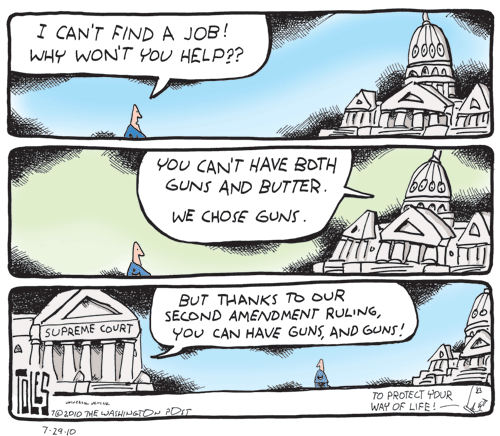
Thanks John Roberts, Samuel Alito, Anthony Kennedy, Antonin Scalia, and Clarence Thomas. This one is at your door. So is this racist drivel:
The ad is courtesy of Americans for Job Security, a murky, euphemistic group that refuses to identify its members:
Our members are businesses, business leaders and entrepreneurs from around the country. AJS does not disclose or discuss its membership further than this.
They go so far as to not disclose the identity of their board, either, and yet they're allowed to spend unlimited money on political campaigns.
The ad also is a page of an old and depiscable conservative playbook: It pits the unemployed of Arkansas against the poor of Bangalore, which has a per capita income of $690 (that's right: $690). I've got think that the real enemy of both are the phantom members of Americans for Job Security, who hide their identities behind the robes of the Supreme Court and chortle with contempt at working people...
Dirty minded Texas Republican uses the right's obsession with porn to kill funding for scientific research and math and science jobs. What's the matter, Ralph? Afraid that if kids learn to add it all up, they won't see it your way?...
Saul Friedman says that government health care works everywhere it's been tried...
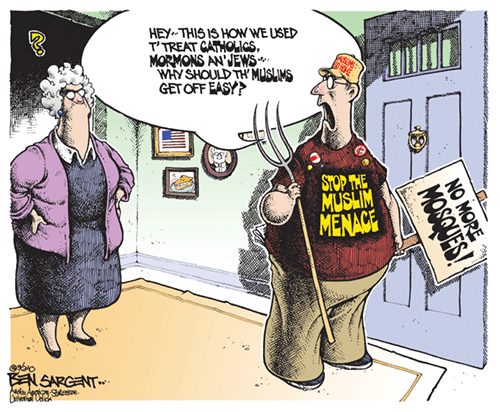
Teabaggers oppose the American people in the name of liberty. What's next? The Fourteenth Amendment? Given the leeway, these people would strip the Constitution they profess to love down the the Second and Tenth Amendments...
GOP senators: TARP worked but -- get this -- the nuances are lost among the tumult and the shouting. According one senator of the party who has made exaggeration, dissembling, and blunt force its political life's blood:
If you can get above all the hyperbolization and misrepresentation and get the facts out, I think you can be very effective...
You never knew what I loved in you; I don't know what you loved in me. Maybe the picture of somebody you were hoping I might be. This one goes out to the good folks at BP/Halliburton:
Today, Jackson Browne releases Solo Acoustic, Vol. 2. This series features live performances from across his entire catalogue, unaccompanied except from himself on piano or guitar. The performances lend an intimacy to the songs; you feel as if he's singing only for you. For Jackson fans, they're no-brainers even if you haveho. If you aren't a fan but are interested, For Everyman and Late For The Sky are good places to start. If you're not a fan, Solo Acoustic won't convert you.
Browne introduces many of the songs with lengthy chats. If you're a fan, you'll appreciate the back stories of these songs. Some reviews, however, complain that the introductions detract from the CDs over repeated listenings because what you really want to hear is the music and not the oral history. On the surface, that's fair enough, except that it fails to account for the utility of iTunes or whatever whatever computerized means you have of downloading .mp3 files either from a CD or from a server. (Agreed, not everyone has access to iTunes. Yet.) It's a simple enough matter to download Solo Acoustic and then create a play list without the spoken word intros.
Which is just one of the things I like about iTunes. When I was in high school back in the early Seventies, a record album cost about $4. For your money, you got 36-38 minutes of music on a piece of vinyl easily subject to damage. Compare that to today, where I can download an album for $10 and usually get close to an hour of music. It turns out that that's a relative bargain: Typically, it takes $21.35 in today's dollars to buy what would have cost $4.00 in 1970, but downloading an album costs $10. (There's a calculator driven by the Consumer Price Indexhere.) And that doesn't account for the additional music: I'd guess that the average release today last from 50-60 minutes.
Much to the dismay of Big Music, downloading has exerted tremendous downward pressure on the price of music. Many people don't bother to pay at all, of course, and even those of us who do like its economy of space as well as of dollars. Software like iTunes allows us to manage our music in ways we could only dream of in the days of albums. At the least, creating a play list was a time-intensive matter of transferring music to a cassette tape one song at a time. Now, its a matter of choosing a command from a menu.
Sure, there are drawbacks to downloading. I don't download classical music or jazz, two genres where the fidelity of CDs makes a difference to me. Downloads rarely come with digital booklets that -- among other things -- credit all of the musicians on an album. But all things considered -- the relative cheapness, the easy storage, the utility -- downloading is a boon to music consumers. It's only a matter of time before the fidelity catches up, anyway.
Get one while they last: Volvo made only 107 of these babies. What are you waiting for?...With Fidel Castro having resigned, will Congress move to lift the wildly successful trade embargo on Cuba?










 Posts


